Beyoglu / Taksim
Istanbul's cosmopolitan soul
Scores
Beyoglu is Istanbul's contemporary heartbeat, the district that embodies the fascinating duality of a city simultaneously looking East and West. Centered around the famous Istiklal Avenue and the iconic Taksim Square, this neighborhood has been for centuries the epicenter of the city's cosmopolitan, artistic, and nightlife scene. If Sultanahmet is Istanbul's monumental history, Beyoglu is its vibrant present: a kaleidoscope of art galleries, rooftop bars, chef-driven restaurants, independent bookshops, concert halls, and human energy that doesn't stop until the early hours.
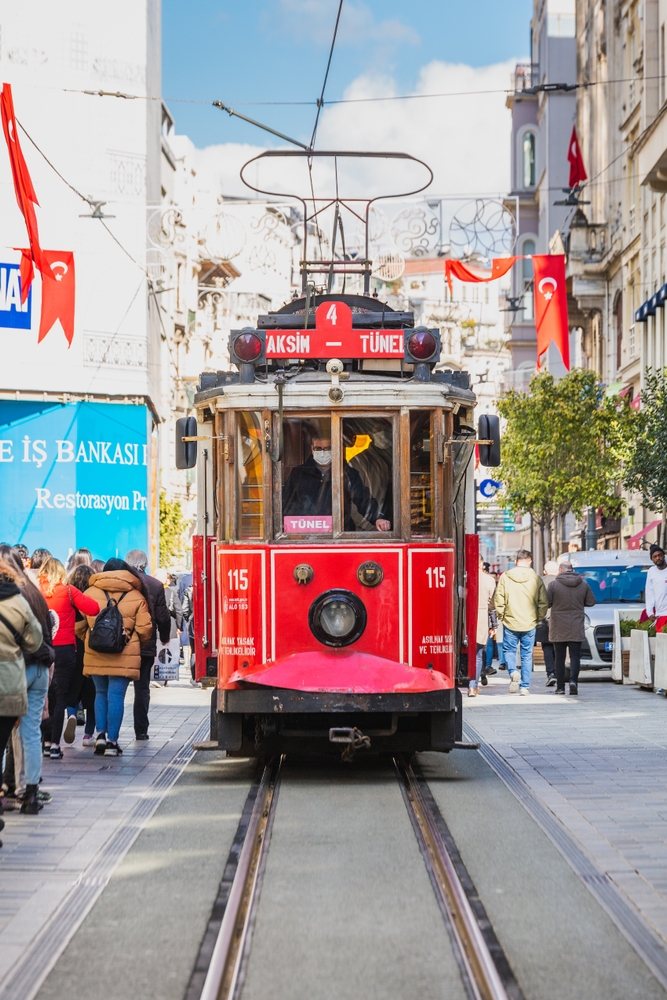
Istiklal Avenue (Istiklal Caddesi) is Beyoglu's backbone, a nearly one-and-a-half-kilometer pedestrian artery connecting Taksim Square with the historic Tunel funicular station — the world's second-oldest underground funicular (opened in 1875, after Budapest's). More than three million people walk this avenue daily, making it one of Europe's busiest streets. Along its length you'll find an eclectic mix of international brands and independent shops, 19th-century glass-roofed passages (like Cicek Pasaji and the European Passage), historic churches, foreign consulates with neoclassical facades, arthouse cinemas, and the iconic red nostalgic tram that traverses the avenue end to end.
Taksim Square is the symbolic heart of modern Istanbul. The Republic Monument at its center commemorates the founding of the Turkish Republic in 1923. The renovated square features the Taksim Mosque (opened 2021) and the rebuilt Ataturk Cultural Center (AKM), a modern performing arts center with opera, theater, and galleries.
The Asmalimescit neighborhood, accessible from Istiklal via several steep alleys, is the epicenter of Istanbul's bohemian nightlife. Its cobblestoned streets are lined with meyhanes (Turkish taverns serving meze and raki), cocktail bars, fusion restaurants, and small art galleries. Nevizade Street is particularly famous — a narrow alley completely occupied by meyhane tables where groups share meze plates, drink raki, and sing folk songs until dawn. It's the quintessential Turkish social experience.
The Cicek Pasaji (Flower Passage) is a 19th-century Art Nouveau arcade housing a row of traditional meyhanes. Behind it lies the Galatasaray Fish Market (Balik Pazari), a bustling alley of fresh fish stalls, seafood, dried fruits, and Turkish delights.
The Pera Museum houses orientalist paintings, Kutahya ceramics, and the iconic "Tortoise Trainer" by Osman Hamdi Bey. The Pera Palace Hotel, built in 1892 as the Orient Express terminal, hosted Agatha Christie (who wrote part of "Murder on the Orient Express" here), Hemingway, Garbo, and Ataturk.
Beyoglu's Art Nouveau architecture is a treasure. Side streets off Istiklal reveal ornate wrought-iron facades, curved balconies, and stained glass rivaling Paris or Brussels. The cultural scene includes the Galata Mevlevi Lodge (whirling dervish ceremonies), St. Antoine Church (Istanbul's largest Catholic church), and contemporary galleries in Tophane and Cihangir.
Transport connections are unbeatable. Metro M2 reaches Taksim, the nostalgic tram runs along Istiklal, and from Kabatas (a short funicular ride from Taksim) you can catch the T1 tram to Sultanahmet or ferries to Asia. This centrality makes Beyoglu an ideal base for exploring the entire city.
The food scene is Turkey's most diverse. Mikla, atop the Marmara Pera hotel, serves acclaimed Turkish-Scandinavian cuisine with panoramic views. Cukur Meyhane offers authentic meze with live music. Karakoy Gulluoglu is Istanbul's baklava benchmark. Zencefil is a pioneering vegetarian restaurant. Rooftop bars like 360 Istanbul and Leb-i Derya offer spectacular nighttime Bosphorus views.
For safety, Beyoglu is generally safe by day, but exercise caution on less-trafficked side streets at night. Pickpockets operate on crowded Istiklal, and be wary of strangers inviting you to bars — the "inflated-bill bar scam" is well-known.
The Cihangir neighborhood deserves special mention. Situated on the hillside descending from Istiklal toward the Bosphorus, Cihangir is Istanbul's Greenwich Village: a neighborhood of artists, writers, expats, and creative professionals who've made its steep streets and bohemian cafes an enclave of tolerance and alternative culture. The Cihangir Mosque terrace is one of the most beautiful and least-known viewpoints in the city. Cafes like Kahvedan, Cuma, and the legendary Smyrna are places where locals spend hours reading, writing, or simply contemplating the views.
Beyoglu's transformation from the Pera district is one of Istanbul's most fascinating urban stories. In the 19th century, Pera was the city's most European quarter, with theaters, operas, French-style cafes, and fashion houses comparable to Parisian boulevards. Decline came in the late 20th century as the cosmopolitan population emigrated. Revitalization began in the 2000s, and today Beyoglu has recovered its shine without losing its character: restored Art Nouveau buildings coexist with graffiti, century-old meyhanes with craft cocktail bars, and historic churches with contemporary art galleries. This creative tension between past and present makes Beyoglu so fascinating.
For shopping, side streets off Istiklal offer radically different experiences from the avenue's mainstream brands. Cukurcuma has dozens of antique and vintage shops, from Ottoman furniture to Art Deco lamps and vinyl records. Galatasaray boutiques offer contemporary Turkish fashion. And in Tophane, the gallery scene has transformed former warehouses into world-class exhibition spaces.
The rebuilt Ataturk Cultural Center (AKM), reopened in 2021, is Taksim's new cultural pole. This multifunctional building houses a 2,000-seat opera hall, theaters, galleries, cinemas, and a public library, plus a rooftop terrace with spectacular views. Programming includes opera, ballet, theater, cinema, and art exhibitions, many free or very affordable.
Beyoglu's side-street gastronomy goes far beyond the featured restaurants. On Sofyali Street, home-style Turkish restaurants (ev yemekleri) serve lunch for under five euros. Historic patisseries like Savoy and Markiz offer Turkish and European desserts. And for breakfast lovers, the extended Turkish kahvalti — dozens of small plates including cheeses, olives, honey, buffalo butter, homemade jams, eggs, sucuk, tomatoes, cucumbers, and fresh bread — reaches its finest expression in Beyoglu, especially at Van Kahvalti Evi.
Beyoglu is ultimately the neighborhood that best represents Istanbul's contemporary spirit: an irresistible blend of history and modernity, tradition and avant-garde, East and West. For cinema lovers, Beyoglu is Turkey's arthouse film center. Atlas Cinema, Beyoglu Sinemasi, and Pera Film offer programming including independent Turkish films and international auteur cinema, often in original language with subtitles. Istanbul's film festivals are headquartered in Beyoglu, and the neighborhood's cinematic tradition dates to the early 20th century, when Turkey's first movie theaters opened on Istiklal.
Gezi Park, beside Taksim Square, is a small green space that gained worldwide fame in 2013 when demolition plans triggered Turkey's largest civil protests in recent history. Today the park still stands — a pleasant spot to rest from Taksim's bustle, with shade from mature trees and square views.
Beyoglu's tea and coffee scene goes far beyond international chains. Cafes like Mandabatmaz, famous for mud-thick Turkish coffee, and Pierre Loti Beyoglu are institutions that have served neighborhood locals for decades. The cay (black Turkish tea) ritual is omnipresent: every shop, workshop, and office has a permanently hot teapot, and accepting a glass of tea offered by a shopkeeper is a fundamental courtesy gesture in Turkish culture.
The Galatasaray Hamami, one of Istanbul's oldest functioning bathhouses dating to 1481, sits right on Istiklal. Unlike the more tourist-oriented hammams of Sultanahmet, this one serves a primarily local clientele and offers an authentic bathing experience at more reasonable prices. The interior marble chambers, steam rooms, and cool-down areas have remained essentially unchanged for five centuries.
For those who enjoy walking tours, Beyoglu rewards exploration of its side streets more than any other Istanbul neighborhood. Every alley off Istiklal hides a surprise: a crumbling Art Nouveau facade, a tiny Armenian church, a courtyard cafe invisible from the street, a record shop specializing in Turkish psychedelic rock from the 1970s, or a workshop where a craftsman has been repairing watches or binding books for forty years. This is the kind of detail that no guidebook can fully capture — and the reason why Beyoglu reveals new layers with every visit.
If you could choose only one neighborhood to experience 21st-century Istanbul, Accommodation in Beyoglu ranges from budget hostels on Taksim side streets to historic luxury hotels like the Pera Palace. The Cihangir area offers charming apartments for longer stays, while the Asmalimescit vicinity is ideal for those wanting to be at the nightlife center. Prices vary considerably: a dormitory hostel costs EUR 15-20, a three-star boutique hotel EUR 70-120, and the Pera Palace starts at EUR 200 per night.
The Galatasaray Hamami, one of Istanbul's oldest functioning bathhouses dating to 1481, sits right on Istiklal. Unlike Sultanahmet's more tourist-oriented hammams, this one serves a primarily local clientele offering authentic bathing at more reasonable prices. The interior marble chambers, steam rooms, and cool-down areas have remained essentially unchanged for five centuries.
For walking tour enthusiasts, Beyoglu rewards side-street exploration more than any other Istanbul neighborhood. Every alley off Istiklal hides a surprise: a crumbling Art Nouveau facade, a tiny Armenian church, a courtyard cafe invisible from the street, a record shop specializing in 1970s Turkish psychedelic rock, or a workshop where a craftsman has been repairing watches for forty years. This is the kind of detail no guidebook can fully capture — and the reason Beyoglu reveals new layers with every visit.
Beyoglu would be the undisputed choice.
Highlights
Where to eat
What to see and do
How to get there
Hotels in Beyoglu / Taksim
Find the best hotels in Beyoglu / Taksim at the best guaranteed price.
See hotels in Beyoglu / Taksim