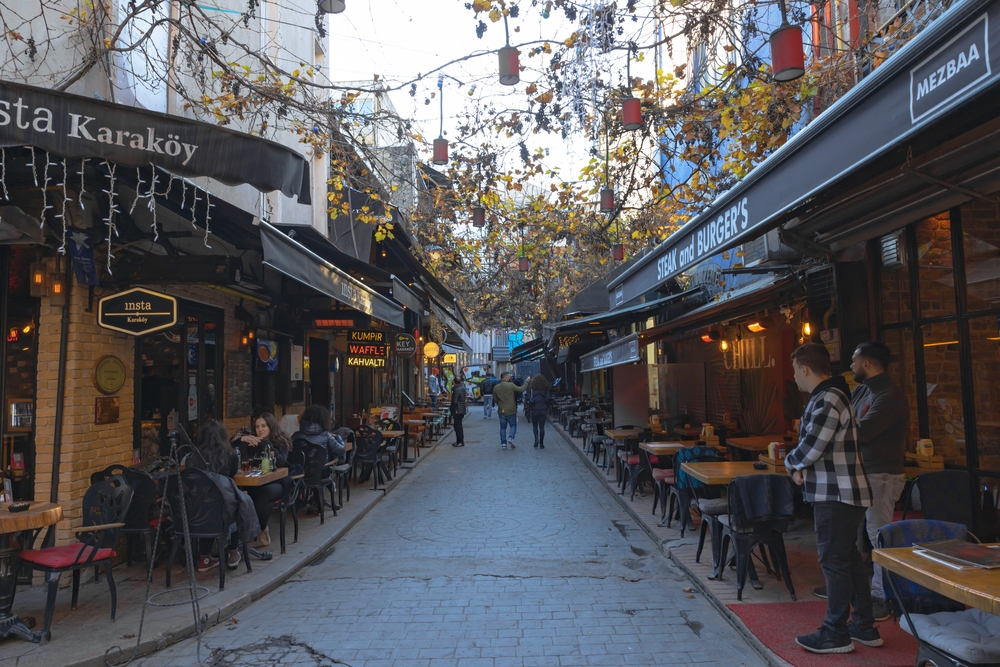
Karakoy / Galata
The creative waterfront neighborhood
Scores
Karakoy and Galata form one of Istanbul's most fascinating and dynamic neighborhoods, where medieval Genoese heritage meets contemporary culture of specialty cafes, art galleries, and boutique hotels housed in former port warehouses. Located on the northern shore of the Golden Horn, just across the Galata Bridge from Eminonu, this neighborhood has undergone one of the most impressive urban transformations in the past two decades, evolving from a somewhat neglected port and industrial district into the epicenter of the city's creative and gastronomic scene.
The Galata Tower (Galata Kulesi) is the visual landmark that dominates this neighborhood's skyline. Originally built by the Genoese in 1348 as part of their trading colony's fortifications, the tower rises 67 meters above one of the city's highest hills, offering 360-degree panoramic views encompassing the Golden Horn, the Bosphorus, the historic peninsula with Hagia Sophia and the Blue Mosque, and on clear days, the Prince's Islands. Ascending to the observation platform at sunset, when golden light bathes the minarets of the old city and ferries cross the Bosphorus leaving silver wakes, is one of Istanbul's most spectacular visual experiences.
Galata's Genoese history is rich and little known. In the 13th century, the Republic of Genoa established a trading colony here that functioned practically as an independent city-state, with its own walls, churches, and governance system. Remnants of the Genoese walls are still visible, and after the Ottoman conquest, the neighborhood maintained its cosmopolitan character, hosting Greek, Armenian, Jewish, and Italian communities.
The third-wave coffee revolution has found its Turkish capital in Karakoy. Dozens of specialty cafes have opened in former warehouses and workshops. Places like Kronotrop, Coffee Sapiens, MOC, and Petra Roasting Co. serve single-origin coffee with artisanal preparation methods in minimalist spaces with industrial design. For coffee lovers, touring Karakoy's cafes is an obligatory pilgrimage.
SALT Galata, housed in the former Ottoman Imperial Bank building (a 19th-century architectural gem designed by Alexandre Vallaury), functions as a contemporary art center, research library, and public space. Its always-free exhibitions address art, architecture, and design with a critical, experimental approach. The bank's original vault has become part of the museum experience.
Istanbul Modern, Turkey's most important contemporary art museum, is nearby in a new Renzo Piano-designed building. Its permanent collection covers Turkish art from the early 20th century to the present, with world-class temporary exhibitions.
The Galata Bridge is more than infrastructure — it's a social theater. Fishermen line the upper railings while restaurants below serve grilled fish with water views. At the Eminonu foot of the bridge, famous balik ekmek boats serve grilled mackerel sandwiches — eating one by the water watching ferries pass is a quintessentially Istanbul moment.
Karakoy Lokantasi elegantly reinterprets Turkish classics with fresh market produce. Namli Gurme is a gourmet deli for Anatolian cheeses, olives, and traditional Turkish breakfast. Karabatak, hidden in a courtyard, was one of the area's first third-wave cafes and remains a local favorite.
Bankalar Caddesi, the former financial center of the Ottoman Empire, features imposing neoclassical buildings being transformed into hotels, galleries, and cultural spaces. Boutique hotels in Karakoy represent the best of contemporary Turkish design — former warehouses and banks converted into characterful accommodations at EUR 80-220 per night.
Transport connections are excellent: T1 tram connects to Sultanahmet and Eminonu, the Tunel funicular reaches Istiklal in ninety seconds, and the Karakoy ferry terminal offers regular lines to the Asian side, Prince's Islands, and along the Bosphorus. The Jewish Museum of Turkey in the Zulfaris Synagogue documents the community's history since the Sephardic arrival from Spain in 1492.
Karakoy's nightlife has its own character. While Beyoglu is frenetic and loud, Karakoy offers a more sophisticated, relaxed experience. Craft cocktail bars like Unter and Alexandra serve artisanal creations in industrial-design spaces. Terrace restaurants on Kemankes Street offer dinners with views of the illuminated old city skyline. Small live music clubs in the streets climbing toward Galata present everything from Turkish jazz to experimental electronica.
Galip Dede Street, climbing from Tunel toward the Galata Tower, is famous for its musical instrument shops. You'll find Turkish lutes (saz, oud, baglama), electric guitars, darbuka drums, and clarinets used in Turkish folk music. The shops are often workshops where artisans handcraft and repair instruments, and it's common to hear someone testing an instrument as you walk by. For musicians or world music enthusiasts, this street is a treasure.
The expat and digital nomad community has found one of its Istanbul gravity centers in Karakoy. Cafes with fast wifi, coworking spaces like Workinton and Kolektif House, and proximity to affordable, varied restaurants make the neighborhood an ideal base for remote workers. The area's rhythm — active during the day, lively but not overwhelming at night — suits this lifestyle perfectly.
The port of Karakoy was for centuries the center of Bosphorus commercial activity. The warehouses now housing cafes and galleries once stored goods from across the Mediterranean and Black Sea. The new cruise terminal adds a modern dimension to this maritime tradition, and seeing large cruise ships docked beside former warehouses is a fascinating visual contrast.
The Tophane area, at Karakoy's western end, is a fascinating transition point between the creative neighborhood and the city's more traditional quarters. Here you'll find the Tophane Fountain, an elegant 18th-century Ottoman kiosk, the Tophane Modern Art Museum, and nargile (water pipe) cafes where Istanbulites sit for hours smoking flavored tobacco and drinking tea. The nargile experience is social and relaxing: you choose your flavor (apple, mint, peach), recline on cushions, and let time pass while perfumed smoke mingles with the Bosphorus breeze. It's a centuries-old tradition experienced in Tophane with an authenticity no longer found in more touristic cafes.
For architecture enthusiasts, Karakoy offers an extraordinary sampling of styles. From 14th-century Genoese wall remnants to Bankalar Caddesi's imposing neoclassical buildings, 19th-century stone port warehouses, and the minimalist interiors of new cafes and hotels, the neighborhood is an open book of five hundred years of architectural history. The mix of old and new, restored and time-worn, gives Karakoy a unique visual character making it a favorite among architects, designers, and photographers worldwide.
The neighborhood's position at the foot of the Galata Bridge also makes it the starting point for one of Istanbul's most iconic walks: crossing the bridge on foot, with fishermen lining both sides and the panorama of the old city gradually revealing itself, then climbing up through the narrow streets toward the Galata Tower. This twenty-minute walk encapsulates much of what makes Istanbul extraordinary — the meeting of water and land, history and modernity, the mundane and the magnificent.
Karakoy-Galata is the perfect neighborhood for travelers seeking a blend of history, creativity, quality gastronomy, and a contemporary urban vibe — the neighborhood that best represents Istanbul's transformation into a 21st-century creative metropolis. For coffee lovers, art enthusiasts, foodies, and travelers who prefer authenticity over mass tourism, Karakoy-Galata is an unbeatable choice.
The walk uphill from Karakoy's shore to the Galata Tower is a microcosm of the neighborhood's history. The path ascends through increasingly narrow streets, passing musical instrument shops, third-wave cafes, Genoese wall remnants, former synagogues, and Art Nouveau buildings in various states of restoration. At each corner, the Golden Horn and old city panorama widens, until from the tower's platform the view encompasses all of Istanbul in every direction. It's a fifteen-minute walk summarizing five hundred years of urban history.
The neighborhood's position makes it one of Istanbul's most strategic bases for sightseeing. The T1 tram reaches Sultanahmet in ten minutes. The Tunel funicular puts Istiklal and Taksim within five minutes. Ferries from the terminal cross to Asia in twenty minutes. And the area between Karakoy and Tophane, along the Bosphorus waterfront, is developing into a restaurant and nightlife corridor that may eventually rival Beyoglu. For travelers who want convenience without the tourist-bubble feel of Sultanahmet, Karakoy-Galata is increasingly the smart choice.
The neighborhood also hosts seasonal cultural events that draw crowds from across the city. The Istanbul Design Biennial often uses SALT Galata and other Karakoy venues as exhibition spaces. The Istanbul Coffee Festival, held annually, celebrates the neighborhood's status as Turkey's cafe capital. And the Galata Rhythm concerts bring live music to various venues throughout the area, further cementing its position as Istanbul's cultural crossroads.
For architecture enthusiasts, Karakoy offers an extraordinary sampling of styles spanning five centuries: from 14th-century Genoese wall remnants to Bankalar Caddesi's imposing neoclassical facades, 19th-century stone port warehouses, and the minimalist industrial interiors of new cafes and hotels. The mix of old and new, restored and time-worn, gives Karakoy a unique visual character that makes it a favorite among architects, designers, and photographers worldwide. Every building tells a story of Galata's layered past — Genoese, Ottoman, European, and now contemporary Turkish — making a simple walk through the neighborhood an architectural education.
Highlights
Where to eat
What to see and do
How to get there
Hotels in Karakoy / Galata
Find the best hotels in Karakoy / Galata at the best guaranteed price.
See hotels in Karakoy / Galata